
Behind every great career lies a story of hard work, learning and passion. Adolfo’s story is an example of how perseverance, the desire to better oneself and the enthusiasm to keep growing can turn a career path into a real adventure.
How did you find out about Skydive Spain, and what made you decide to start working here?
I heard about you through a friend and client from my previous job, Diego, a skydiver who used to visit the dropzone quite often and whom I turned to for information as soon as I realised I wanted to become a skydiver
Shortly after getting my licence, I realised that working in this industry was the best way to become a professional, so I literally put my life on hold, packed my things and moved here as soon as that long-awaited call came through.
Do you remember your first day at the centre? What was your impression?
It feels like it was only yesterday, 16 September 2022, when my theory session began at 9 am with Mario, who is now one of my classmates. I was amazed by the number of countries and cultures this sport can bring together, especially in a small village in Seville. Shortly after it finished, I made my first tandem jump and knew I’d found my place.
Did you ever imagine you’d end up as an instructor?
It was quite a struggle for me. It had been my plan almost since before I became a skydiver. I’m not going to lie to you. I’ve been an instructor in other sports and, thanks to some great teachers, I feel a strong calling to teach. Let’s just say that skydiving was the next level to which I wanted to take that calling and, naturally, I realised just how ambitious and tough that path could be, but well, here we are.
What was your first skydiving experience like?
It wasn’t at all what I’d expected. I’d pictured that scene in my head thousands of times. Each time, I’d imagined feeling the adrenaline, the rush and the euphoria typical of a sport like this, but no, it was exactly the opposite. The emptiness, the vastness, the fresh air, the swaying of the parachute. Everything seemed to fit perfectly with what I’d always understood in my mind to mean ‘being at peace’.
What surprised you most about the working environment and the skydiving community?
Above all, how people are capable of changing absolutely everything just to be close to this sport. And don’t get me wrong, I mean that in a good way.
What do you remember most about those first few months as part of the ground crew?
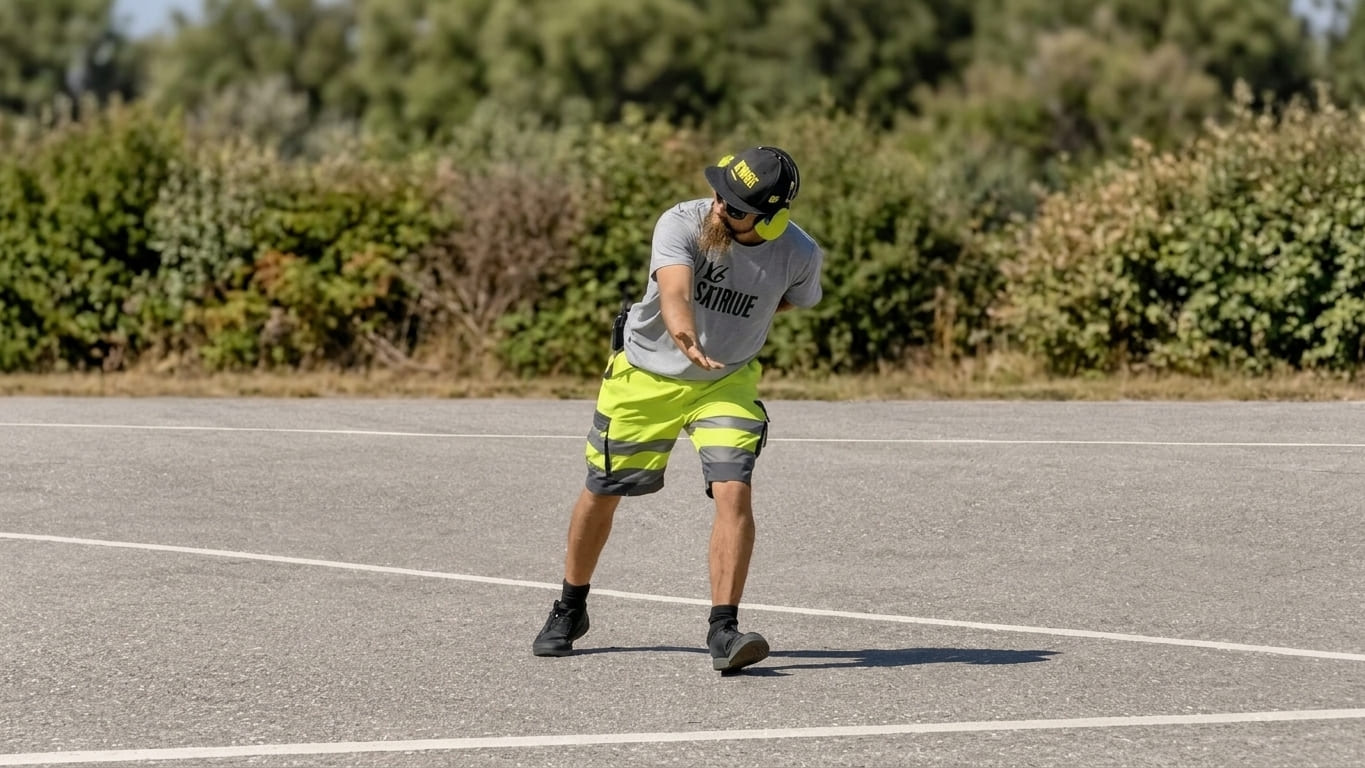
Running and lots of it. I’ve always been a bundle of nerves, and it hasn’t got any better with age. I loved rushing from one task to the next without stopping. Refuelling, radio communication with the planes, collecting equipment, setting off in search of lost paratroopers. I saw it, and still see it , as the perfect job for me.
When did you first start thinking about becoming a skydiver?
I suppose it’s something that’s been with me all my life. I’ve done skateboarding, aggressive skating, parkour, free climbing on buildings, paragliding, martial arts… deep down, I knew that getting on board to jump out of a plane was only a matter of time.
What motivated you to take the plunge and become a skydiving instructor?
To see the impact this sport has on people’s lives. Skydiving has a way of changing your life, and one of the key moments in that change is the learning process. Right from the start, I knew I wanted to be part of that process – to learn the sport, to be able to teach it, and to bring it to as many people as possible, whether they are future skydivers or tandem passengers.
What was the biggest challenge you faced whilst training to become an instructor?
Above all, learning to connect with the teaching. In other sports, it is easy to incorporate practice into the theory itself and create a comfort zone in which to practise. In skydiving, that is impossible. Jumps are expensive, time-limited and influenced by adrenaline and stress, so it is a challenge to ensure that students board the plane fully prepared using only videos, images and theoretical explanations
What differences do you notice between jumping on your own and accompanying someone who is making their first jump?
Jumping is always brilliant, but when you’re there to support someone as they take their first steps, you can’t help but remember just how special that first experience of the sport is. Being part of that first experience for someone else is always a privilege.
What have you learnt about communication, patience and safety since becoming an instructor?
Above all, understanding how this sport affects the brain. When you communicate with students or other skydivers, you do so in an environment of constant stimulation, which requires a certain level of patience and empathy in order to communicate effectively and connect with others.
How has Skydive Spain helped you to develop professionally?
The company has gone out of its way to support me. It has given me access to all sorts of equipment, allowed me to practise my jumps whenever I needed to train, and many members have helped out during my training sessions and assessments. Not to mention that as soon as I obtained my qualifications, the company paved the way for me to gain experience in those areas by allowing me to take part in the instructors’ activities as an apprentice.
Which people have played an important role in your career development?
Above all, my family, who have followed my entire journey closely. Some of my nieces are already showing promise, so I hope to have them as pupils here very soon. I’d also like to mention the family I’ve got to know whilst working here. They’re a brilliant bunch of people with whom I’ve shared a home, a car, the gym and countless hours of jumping, studying and training.
What does it mean to you to have built a career in an environment like this?
To have something of value that is worth cherishing, nurturing and sharing with those who wish to join us on this journey.
What do you love most about skydiving?
Teaching other people and being part of that process where we expose ourselves to a completely new environment, forcing us to learn entirely from scratch. It’s almost like teaching someone to walk for the first time.
What have you learnt about yourself through this sport?
What I’m capable of doing to achieve a goal. Now, every idea I set my mind to seems a little less far-fetched. In fact, becoming a skydiving instructor made me realise that the problem in my life wasn’t that my ideas were too crazy, it was that they weren’t crazy enough.
What is it that still excites you after so many jumps?
The privilege of flying, of being in a place we see every day and take for granted. Soaring through the sky and the clouds and seeing it all from so high up is something that never ceases to be special.
What do you do when you’re not working or jumping?
Well, there are very few times when I’m not working or base jumping. I usually like to stick to my routines of going to the gym, skating, doing a bit of DIY at home and, whenever I can, base jumping.
What moment in your career makes you feel most proud?
I couldn’t say. Many colleagues and skydivers have helped me, even before I started working here. Behind every achievement there are one or more people who, at the time, gave me support and help so that I could move forward – whether it was picking me up from the station to come skydiving, lending me a parachute or altimeter, or coming along for days on end to help me with my training. So, if I had to be proud of anything, it would be that I’m surrounded by good people.
What advice would you give to someone who has just joined Skydive Spain and wants to progress within the company?
I hope you enjoy your work. Any job can be the toughest of all, but we work surrounded by aeroplanes, parachutes and people who are truly out of the ordinary. We have all the tools we need to make our working day stimulating and rewarding, and by embracing that philosophy, you can become a motivated and productive employee.
How would you like your career in skydiving to develop?
At the moment, my focus is on establishing myself as an instructor, gaining experience and improving both my flying techniques and my teaching methods. I always have one eye on the next step, but right now, I’m exactly where I want to be.